Background-
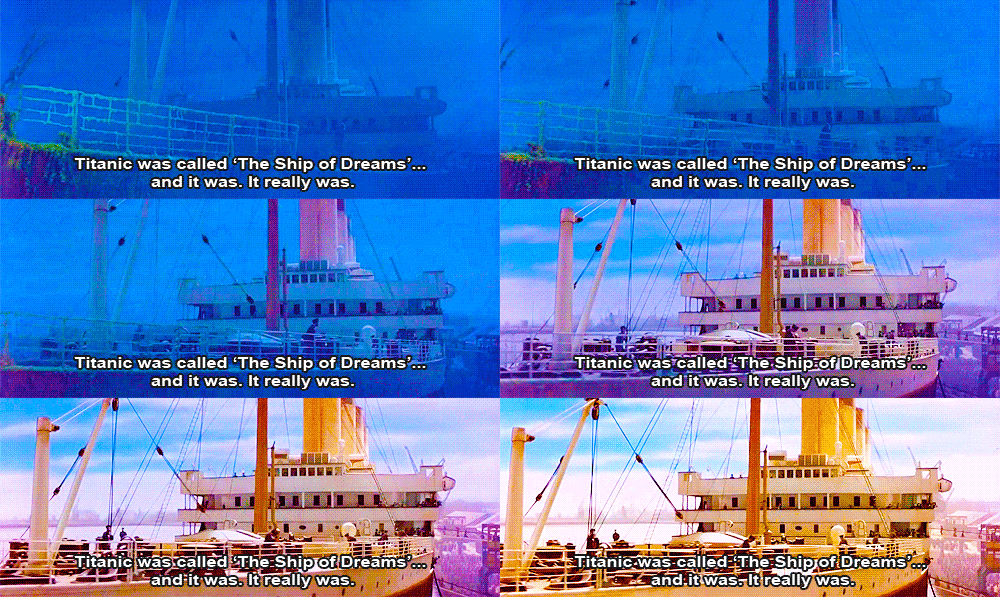
The name Titanic was derived from Greek mythology and meant gigantic. Built in Belfast, Ireland, in the United Kingdom of Great Britain and Ireland (as it then was), the RMS Titanic was the second of the three Olympic-class ocean liners—the first was the RMSOlympic and the third was the HMHS Britannic. They were by far the largest vessels of the British shipping company White Star Line's fleet, which comprised 29 steamers and tenders in 1912. The three ships had their genesis in a discussion in mid-1907 between the White Star Line's chairman, J. Bruce Ismay, and the American financier J. P. Morgan, who controlled the White Star Line's parent corporation, the International Mercantile Marine Co. (IMM).
The White Star Line faced a growing challenge from its main rivals Cunard, which had just launched the Lusitania and the Mauretania— the fastest passenger ships then in service — and the German lines Hamburg America and Norddeutscher Lloyd. Ismay preferred to compete on size rather than speed and proposed to commission a new class of liners that would be bigger than anything that had gone before as well as being the last word in comfort and luxury. The company sought an upgrade in their fleet primarily in response to the Cunard giants but also to replace their oldest pair of passenger ships still in service, being the SS Teutonic of 1889 and SSMajestic of 1890. Teutonic was replaced by Olympic while Majestic was replaced by Titanic. Majestic would be brought back into her old spot on White Star's New York service after Titanic's loss.
The ships were constructed by the Belfast shipbuilders Harland and Wolff, who had a long-established relationship with the White Star Line dating back to 1867. Harland and Wolff were given a great deal of latitude in designing ships for the White Star Line; the usual approach was for the latter to sketch out a general concept which the former would take away and turn into a ship design. Cost considerations were relatively low on the agenda and Harland and Wolff was authorised to spend what it needed on the ships, plus a five percent profit margin. In the case of the Olympic-class ships, a cost of £3 million for the first two ships was agreed plus "extras to contract" and the usual five percent fee.
Harland and Wolff put their leading designers to work designing the Olympic-class vessels. The design was overseen by Lord Pirrie, a director of both Harland and Wolff and the White Star Line; naval architect Thomas Andrews, the managing director of Harland and Wolff's design department; Edward Wilding, Andrews' deputy and responsible for calculating the ship's design, stability and trim; andAlexander Carlisle, the shipyard's chief draughtsman and general manager. Carlisle's responsibilities included the decorations, equipment and all general arrangements, including the implementation of an efficient lifeboat davit design.
On 29 July 1908, Harland and Wolff presented the drawings to J. Bruce Ismay and other White Star Line executives. Ismay approved the design and signed three "letters of agreement" two days later authorising the start of construction. At this point the first ship—which was later to become Olympic—had no name, but was referred to simply as "Number 400", as it was Harland and Wolff's four hundredth hull. Titanic was based on a revised version of the same design and was given the number 401.
Features-
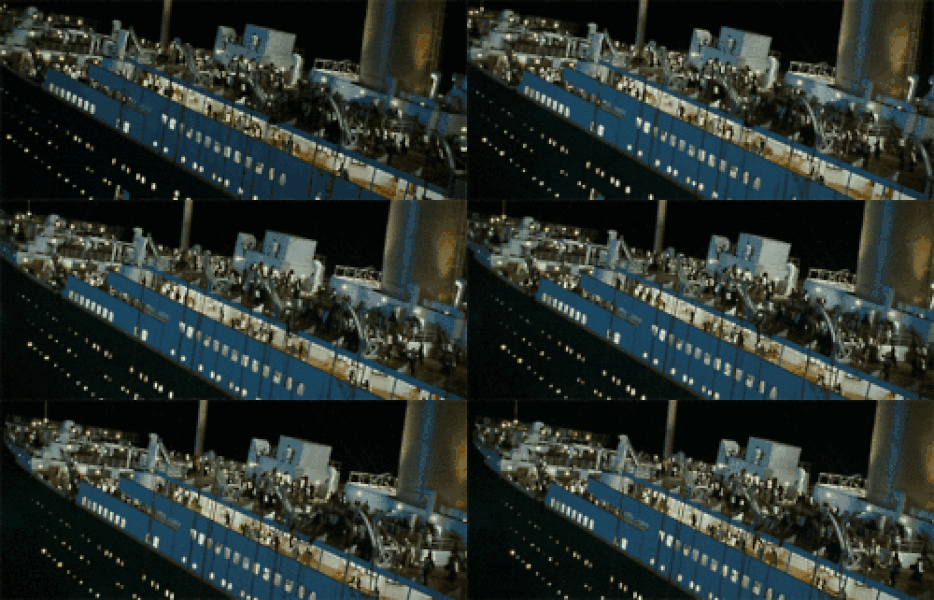
Titanic was equipped with three main engines—two reciprocating four-cylinder, triple-expansionsteam engines and one centrally placed low-pressure Parsons turbine—each driving a propeller. The two reciprocating engines had a combined output of 30,000 hp and a further 16,000 hp was contributed by the turbine. The White Star Line had used the same combination of engines on an earlier liner, the SS Laurentic, where it had been a great success. It provided a good combination of performance and speed; reciprocating engines by themselves were not powerful enough to propel an Olympic-class liner at the desired speeds, while turbines were sufficiently powerful but caused uncomfortable vibrations, a problem that affected the all-turbine Cunard linersLusitania and Mauretania. By combining reciprocating engines with a turbine, fuel usage could be reduced and motive power increased, while using the same amount of steam. The two reciprocating engines were each 63 feet (19 m) long and weighed 720 tons, with their bedplates contributing a further 195 tons. They were powered by steam produced in 29 boilers, 24 of which were double-ended and 5 single-ended, which contained a total of 159 furnaces. The boilers were 15 feet 9 inches (4.80 m) in diameter and 20 feet (6.1 m) long, each weighing 91.5 tons and capable of holding 48.5 tons of water. They were heated by burning coal, 6,611 tons of which could be carried in Titanic's bunkers with a further 1,092 tons in Hold 3. The furnaces required over 600 tons of coal a day to be shovelled into them by hand, requiring the services of 176 firemen working around the clock. 100 tons of ash a day had to be disposed of by ejecting it into the sea. The work was relentless, dirty and dangerous, and although firemen were paid relatively generously there was a high suicide rate among those who worked in that capacity.
Exhaust steam leaving the reciprocating engines was fed into the turbine, which was situated aft. From there it passed into a condenser, to increase the efficiency of the turbine and so that the steam could be condensed back into water and reused. The engines were attached directly to long shafts which drove the propellers. There were three, one for each engine; the outer (or wing) propellers were the largest, each carrying three blades of manganese-bronze alloy with a total diameter of 23.5 feet (7.2 m). The middle propeller was slightly smaller at 17 feet (5.2 m) in diameter, and could be stopped but not reversed.
Titanic's electrical plant was capable of producing more power than an average city power station of the time. Immediately aft of the turbine engine were four 400 kW steam-driven electric generators, used to provide electrical power to the ship, plus two 30 kW auxiliary generators for emergency use. Their location in the stern of the ship meant that they remained operational until the last few minutes before the ship sank.
Passenger facilities-
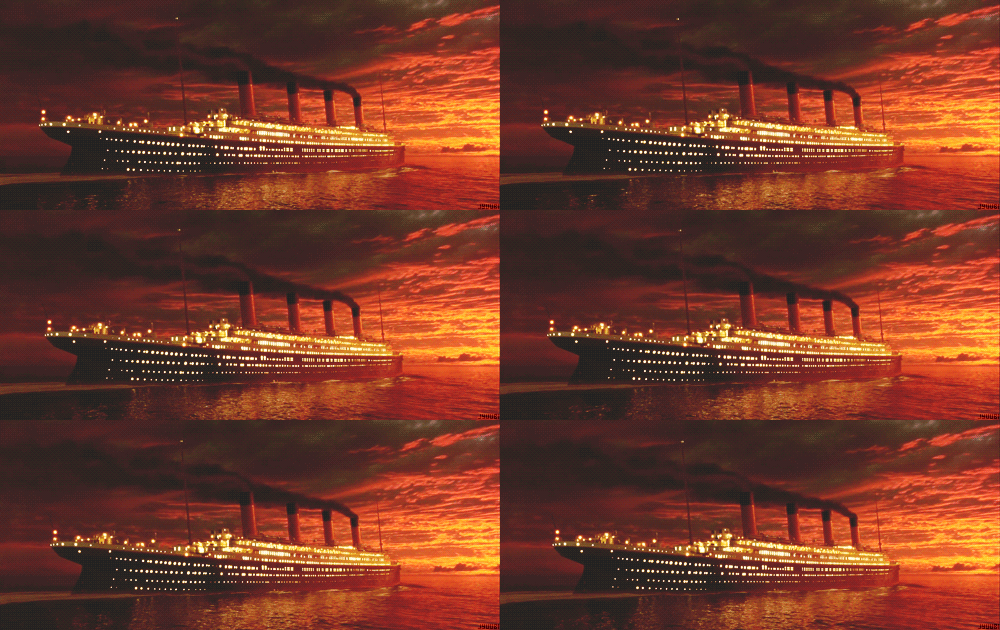
The passenger facilities aboard Titanic aimed to meet the highest standards of luxury. According to Titanic's general arrangement plans, the ship could accommodate 833 First Class Passengers, 614 in Second Class and 1,006 in Third Class, for a total passenger capacity of 2,453. In addition, her capacity for crew members exceeded 900, as most documents of her original configuration have stated that her full carrying capacity for both passengers and crew was approximately 3,547. Her interior design was a departure from that of other passenger liners, which had typically been decorated in the rather heavy style of a manor house or an English country house.
Titanic was laid out in a much lighter style similar to that of contemporary high-class hotels—the Ritz Hotel was a reference point—with First Class cabins finished in the Empire style. A variety of other decorative styles, ranging from the Renaissance to Victorian, were used to decorate cabins and public rooms in First and Second Class areas of the ship. The aim was to convey an impression that the passengers were in a floating hotel rather than a ship; as one passenger recalled, on entering the ship's interior a passenger would "at once lose the feeling that we are on board ship, and seem instead to be entering the hall of some great house on shore".
Passengers could use an on-board telephone system, a lending library and a large barber shop. The First Class section had a swimming pool, a gymnasium, a squash court, a Turkish bath, an electric bath and a Verandah Cafe. First Class common rooms were adorned with ornate wood panelling, expensive furniture and other decorations, while the Third Class general room had pine panelling and sturdy teak furniture. The Café Parisien was located on a sunlit veranda fitted with trellis decorations and offered the best French haute cuisine for First Class passengers. Third Class (also commonly referred to as Steerage) accommodations aboard Titanic were not as luxurious as First Class, but even so were better than on many other ships of the time. They reflected the improved standards which the White Star Line had adopted for trans-Atlantic immigrant and lower-class travel. On most other North Atlantic passenger ships at the time, Third Class accommodations consisted of little more than open dormitories in the forward end of the vessels, in which hundreds of people were confined, often without adequate food or toilet facilities,.
The White Star Line had long since broken that mold. As seen aboard Titanic, all White Star Line passenger ships divided their Third Class accommodations into two sections, always at opposite ends of the vessel from one another. The established arrangement was that single men were quartered in the forward areas, while single women, married couples and families were quartered aft. In addition, while other ships provided only open berth sleeping arrangements, White Star Line vessels provided their Third Class passengers with private, small but comfortable cabins capable of accommodating two, four, six, eight and ten passengers.
Third Class accommodations also included their own dining rooms, as well as public gathering areas including adequate open deck space, which aboard Titanic included the Forecastle Deck forward, the Poop Deck aft, both well decks and a large open space on D Deck which could be used as a social hall. This was supplemented by the addition of a smoking room for men and a reading room for women, and although they were not as glamorous in design as spaces seen in upper class accommodations, they were still far above average for the period. Leisure facilities were provided for all three classes to pass the time. As well as making use of the indoor amenities such as the library, smoking rooms, and gymnasium, it was also customary for passengers to socialise on the open deck, promenading or relaxing in hired deck chairs or wooden benches. A passenger list was published before the sailing to inform the public which members of the great and good were on board, and it was not uncommon for ambitious mothers to use the list to identify rich bachelors to whom they could introduce their marriageable daughters during the voyage.
One of Titanic's most distinctive features was her First Class staircase, known as the Grand Staircase or Grand Stairway. This descended through seven decks of the ship, from the Boat Deck to E deck in the elegant style depicted in photographs and movies, and then as a more functional and less elegant staircase from there down to F deck. It was capped with a dome of wrought iron and glass that admitted natural light. Each landing off the staircase gave access to ornate entrance halls lit by gold-plated light fixtures.
At the uppermost landing was a large carved wooden panel containing a clock, with figures of "Honour and Glory Crowning Time" flanking the clock face. The Grand Staircase was destroyed in Titanic's sinking and is now just a void in the ship which modern explorers have used to access the lower decks. During the filming of James Cameron's Titanic in 1997, his replica of the Grand Staircase was ripped from its foundations by the force of the inrushing water on the set. It has been suggested that during the real event, the entire Grand Staircase was ejected upwards through the dome.
In Film(1997):-
Plot-
In 1996, treasure hunter Brock Lovett and his team aboard the research vesselKeldysh search the wreck of RMS Titanic for a necklace with a rare diamond, the Heart of the Ocean. They recover a safe containing a drawing of a young woman wearing only the necklace. The drawing is dated April 14, 1912, the day Titanic struck the iceberg. Rose Dawson Calvert claims to be the person in the drawing, visits Lovett and tells of her experiences aboard Titanic.
In 1912 Southampton, 17-year-old first-class passenger Rose DeWitt Bukater, her fiancé Cal Hockley and her mother Ruth boardTitanic. Ruth emphasizes that Rose's marriage will resolve the DeWitt Bukaters' financial problems. Distraught over the engagement, Rose considers committing suicide by jumping from the stern; Jack Dawson, a penniless artist, convinces her not to. Discovered with Jack, Rose tells Cal she was peering over the edge and Jack saved her from falling. Cal is indifferent, but when Rose indicates some recognition is due, he offers Jack a small amount of money. After Rose asks whether saving her life meant so little, he invites Jack to dine with them in first class the following night. Jack and Rose develop a tentative friendship, though Cal and Ruth are wary of him. Following dinner, Rose secretly joins Jack at a party in third class.
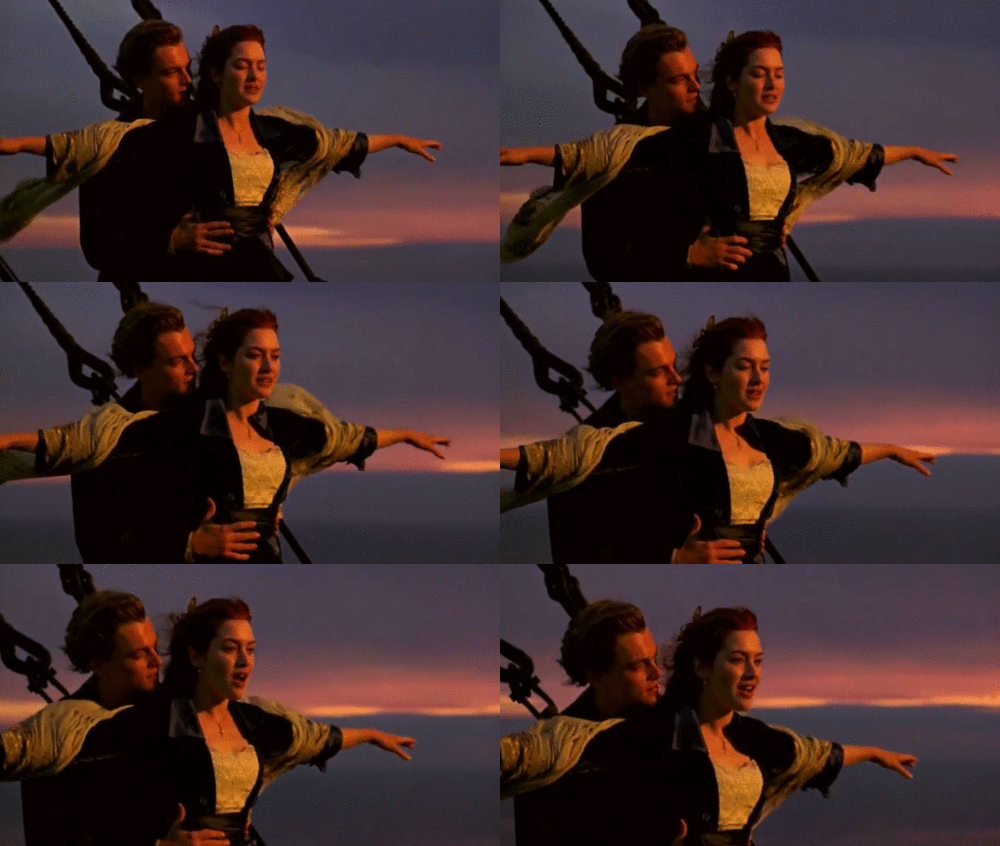
Aware of Cal and Ruth's disapproval, Rose rebuffs Jack's advances, but later realizes she prefers him to Cal. After rendezvousing on the stern at sunset, Rose takes Jack to her stateroom and displays Cal's engagement present: the Heart of the Ocean. At her request, Jack sketches Rose posing nude wearing the necklace. They evade Cal's bodyguard and have sex in an automobile in the ship's cargo hold. The pair later visits the ship's forward deck, witnessing a collision with an iceberg and overhearing the ship's officers and designer discussing its seriousness.
Cal discovers Jack's sketch of Rose and a mocking note from her in his safe along with the necklace. When Jack and Rose attempt to tell Cal of the collision, Cal has his manservant slip the necklace into Jack's pocket and accuses him of theft. Jack is arrested, taken to the Master-at-arms' office, and handcuffed to a pipe. Cal puts the necklace in his own coat pocket.
With the ship sinking, Rose is desperate to free Jack. She flees Cal and her mother, who has boarded a lifeboat, and rescues Jack. They return to the top deck, where Cal and Jack encourage her to board a lifeboat; Cal claims he can get himself and Jack off safely. After Rose boards, Cal tells Jack the arrangement is only for himself. As her boat lowers, Rose decides she cannot leave Jack and jumps back on board. Cal takes his manservant's pistol and chases Rose and Jack into the flooding first-class dining saloon. After using up his ammunition, Cal realizes he gave his coat and consequently the diamond to Rose. Cal boards a lifeboat by carrying a lost child.
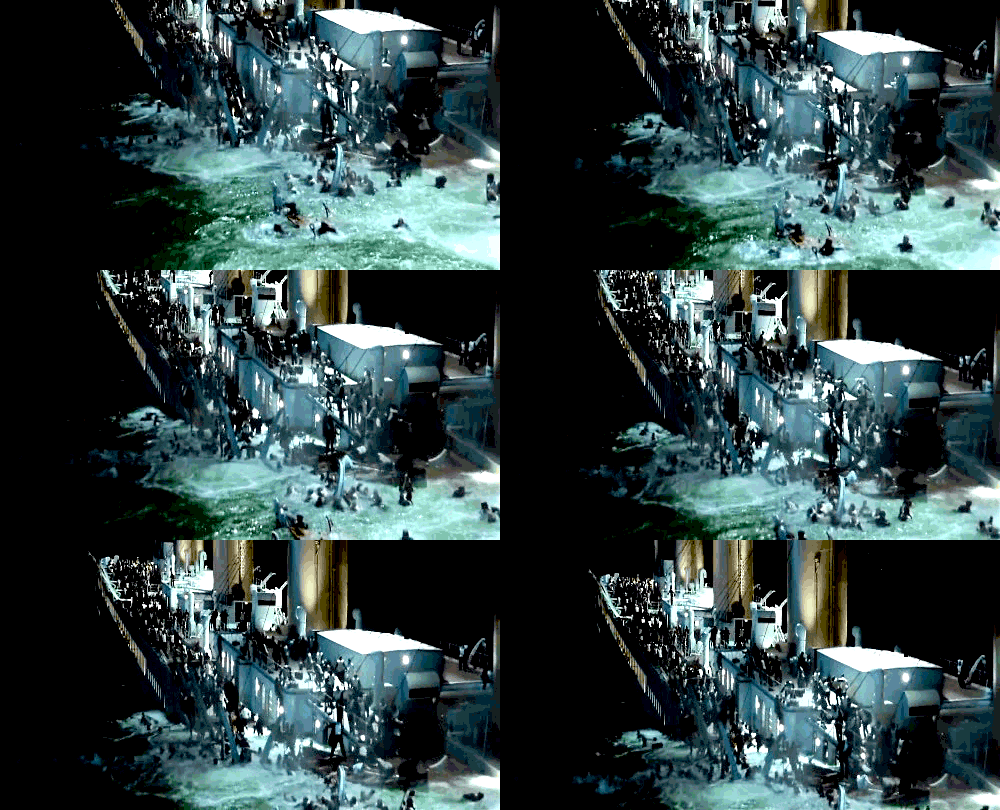
After braving several obstacles, Jack and Rose return to the boat deck. All lifeboats have departed and passengers are falling to their deaths as the stern rises from the water. The ship breaks in half, lifting the stern into the air. Jack and Rose ride the stern into the ocean and he helps her onto a wooden panel only buoyant enough for one person. Holding the edge, Jack assures Rose she will die an old woman, warm in her bed. He dies from hypothermia but Rose is saved.
With Rose hiding from Cal en route, the RMS Carpathia takes the survivors to New York. There Rose gives her name as Rose Dawson. She later learns Cal committed suicide after losing everything in the 1929 Wall Street Crash.
Hearing Rose's story, Lovett abandons his search. Alone on the stern of Keldysh, Rose takes out the Heart of the Ocean—in her possession all along—and drops it into the sea over the wreck site. While she is seemingly asleep in her bed, photos on her dresser depict a life of freedom and adventure, partly inspired by Jack. A young Rose reunites with Jack at the ship's Grand Staircase, applauded by those who perished.
Writing and inspiration-
James Cameron had a fascination with shipwrecks, and, for him, the RMS Titanic was "the Mount Everest of shipwrecks. He was almost past the point in his life when he felt he could consider an undersea expedition, but said he still had "a mental restlessness" to live the life he had turned away from when he switched from the sciences to the arts in college. So when an IMAX film was made from footage shot of the wreck itself, he decided to seek Hollywood funding to "pay for an expedition and do the same thing." It was "not because I particularly wanted to make the movie," Cameron said. "I wanted to dive to the shipwreck."
Cameron wrote a scriptment for a Titanic film, met with 20th Century Fox executives including Peter Chernin, and pitched it as "Romeo and Juliet on the Titanic". Cameron stated, "They were like, 'Oooooohkaaaaaay – a three-hour romantic epic? Sure, that's just what we want. Is there a little bit of Terminator in that? Any Harrier jets, shoot-outs, or car chases?' I said, 'No, no, no. It's not like that.'" The studio was dubious about the idea's commercial prospects, but, hoping for a long term relationship with Cameron, they gave him a greenlight.
Cameron convinced Fox to promote the film based on the publicity afforded by shooting the Titanic wreck itself, and organized several dives to the site over a period of two years. "My pitch on that had to be a little more detailed," said Cameron. "So I said, 'Look, we've got to do this whole opening where they're exploring the Titanic and they find the diamond, so we're going to have all these shots of the ship." Cameron stated, "Now, we can either do them with elaborate models and motion control shots and CG and all that, which will cost X amount of money – or we can spend X plus 30 per cent and actually go shoot it at the real wreck." The crew shot at the real wreck in the Atlantic Ocean eleven times in 1995 and actually spent more time with the ship than its passengers. At that depth, with a water pressure of 6,000 pounds per square inch, "one small flaw in the vessel's superstructure would mean instant death for all on board." Not only were the dives high-risk, but adverse conditions prevented Cameron from getting the high quality footage that he wanted. During one dive, one of the submersibles collided with Titanic's hull, damaging both sub and ship and leaving fragments of the submersible's propeller shroud scattered around the superstructure. The external bulkhead of Captain Smith's quarters collapsed, exposing the interior. The area around the entrance to the Grand Staircase was also damaged.
Descending to the actual site made both Cameron and crew want "to live up to that level of reality.... But there was another level of reaction coming away from the real wreck, which was that it wasn't just a story, it wasn't just a drama," he said. "It was an event that happened to real people who really died. Working around the wreck for so much time, you get such a strong sense of the profound sadness and injustice of it, and the message of it." Cameron stated, "You think, 'There probably aren't going to be many filmmakers who go to Titanic. There may never be another one – maybe a documentarian." Due to this, he felt "a great mantle of responsibility to convey the emotional message of it – to do that part of it right, too".
After filming the underwater shots, Cameron began writing the screenplay. He wanted to honor the people who died during the sinking, so he spent six months researching all of the Titanic's crew and passengers. "I read everything I could. I created an extremely detailed timeline of the ship's few days and a very detailed timeline of the last night of its life," he said. "And I worked within that to write the script, and I got some historical experts to analyze what I'd written and comment on it, and I adjusted it."He paid meticulous attention to detail, even including a scene depicting the Californian's role in Titanic's demise, though this was later cut. From the beginning of the shoot, they had "a very clear picture" of what happened on the ship that night. "I had a library that filled one whole wall of my writing office with "Titanic stuff," because I wanted it to be right, especially if we were going to dive to the ship," he said. "That set the bar higher in a way – it elevated the movie in a sense. We wanted this to be a definitive visualization of this moment in history as if you'd gone back in a time machine and shot it."
Cameron felt the Titanic sinking was "like a great novel that really happened", yet the event had become a mere morality tale; the film would give audiences the experience of living the history. The treasure hunter Brock Lovett represented those who never connected with the human element of the tragedy, while the blossoming romance of Jack and Rose, he believed, would be the most engaging part of the story: when their love is finally destroyed, the audience would mourn the loss. "All my films are love stories," Cameron said, "but in Titanic I finally got the balance right. It's not a disaster film. It's a love story with a fastidious overlay of real history."Cameron then framed the romance with the elderly Rose to make the intervening years palpable and poignant. For him, the end of the film leaves open the question if the elderly Rose was in a conscious dream or had died in her sleep.
Production-
The modern day scenes of the expedition were shot on the Akademik Mstislav Keldysh in July 1996. Principal photography forTitanic began in September 1996 at the newly built Fox Baja Studios. The poop deck was built on a hinge which could rise from zero to ninety degrees in a few seconds as the ship's stern rose during the sinking. For the safety of the stuntmen, many props were made of foam rubber. By November 15, the boarding scenes were being shot.Cameron chose to build his RMS Titanic on the starboard side as a study of weather data showed prevailing north-to-south wind which blew the funnel smoke aft. This posed a problem for shooting the ship's departure from Southampton, as it was docked on its port side. Any writing on props and costumes had to be reversed, and if someone walked to their right in the script, they had to walk left during shooting. In post-production, the film was flipped to the correct direction.
A full-time etiquette coach was hired to instruct the cast on the manners of the upper class gentility in 1912. Despite this, several critics picked up on anachronisms in the film, not least involving the two main stars
Other times on the set were not as smooth. The shoot was an arduous experience that "cemented Cameron's formidable reputation as 'the scariest man in Hollywood'. He became known as an uncompromising, hard-charging perfectionist" and a "300-decibel screamer, a modern-day Captain Bligh with a megaphone and walkie-talkie, swooping down into people's faces on a 162ft crane". Winslet chipped a bone in her elbow during filming, and had been worried that she would drown in the 17m-gallon water tank the ship was to be sunk in. "There were times when I was genuinely frightened of him. Jim has a temper like you wouldn't believe," she said. "'God damn it!' he would yell at some poor crew member, 'that's exactly what I didn't want!'"Her co-star, Bill Paxton, was familiar with Cameron's work ethic from his earlier experience with him. "There were a lot of people on the set. Jim is not one of those guys who has the time to win hearts and minds," he said.The crew felt that Cameron had an evil alter ego, and nicknamed him "Mij" (Jim spelt backwards). In response to the criticism, Cameron stated, "Film-making is war. A great battle between business and aesthetics."
During shooting on the Akademik Mstislav Keldysh, an angry crew member put the dissociative drug PCP into the soup that Cameron and various others ate one night, which sent more than 50 people to the hospital. "There were people just rolling around, completely out of it. Some of them said they were seeing streaks and psychedelics," said actor Lewis Abernathy. Cameron managed to vomit before the drug took a full hold. Abernathy was shocked at the way he looked. "One eye was completely red, like the Terminator eye. A pupil, no iris, beet red. The other eye looked like he'd been sniffing glue since he was four.The person behind the poisoning was never caught.
The filming schedule was intended to last 138 days but grew to 160. Many cast members came down with colds, flu, or kidney infections after spending hours in cold water, including Winslet. In the end, she decided she would not work with Cameron again unless she earned "a lot of money".Several others left and three stuntmen broke their bones, but the Screen Actors Guild decided, following an investigation, that nothing was inherently unsafe about the set. Additionally, DiCaprio said there was no point when he felt he was in danger during filming. Cameron believed in a passionate work ethic and never apologized for the way he ran his sets, although he acknowledged:
The costs of filming Titanic eventually began to mount, and finally reached $200 million.Fox executives panicked, and suggested an hour of specific cuts from the three-hour film. They argued the extended length would mean fewer showings, thus less money even though long epics are more likely to help directors win Oscars. Cameron refused, telling Fox, "You want to cut my movie? You're going to have to fire me! You want to fire me? You're going to have to kill me!"The executives did not want to start over, because it would mean the loss of their entire investment, but they also initially rejected Cameron's offer of forfeiting his share of the profits as an empty gesture; they felt that profits would be unlikely. Cameron explained forfeiting his share as complex. "...the short version is that the film cost proportionally much more than T2 and True Lies. Those films went up seven or eight percent from the initial budget. Titanic also had a large budget to begin with, but it went up a lot more," said Cameron. "As the producer and director, I take responsibility for the studio that's writing the checks, so I made it less painful for them. I did that on two different occasions. They didn't force me to do it; they were glad that I did."
Commercial analysis-
When the film became a success, with an unprecedented box office performance, it was credited as "the love story [that] stole the world's hearts". "The first batch of people to see it [were] gob smacked by the sheer scale and intimacy of the production. They emerged from the cinema, tear stained and emotionally flabbergasted." The film was playing on 3,200 screens ten weeks after it opened, and out of its fifteen straight weeks on top of the charts, jumped 43% in total sales in its ninth week of release. It earned over $20 million a week for ten weeks, and after 14 weeks was still bringing in more than $1m a week. 20th Century Fox estimated that seven percent of American teenage girls had seen Titanic twice by its fifth week.Although young women who saw the film several times, and subsequently caused "Leo-Mania", were often credited with having primarily propelled the film to its all-time box office record, other reports have attributed the film's success to "[p]ositive word of mouth and repeat viewership" due to the love story combined with the ground-breaking special effects. The film's impact on men has also been especially credited.Now considered one of the films that "make men cry",MSNBC's Ian Hodder stated that men admire Jack's sense of adventure, stowing away on a steamship bound for America. "We cheer as he courts a girl who was out of his league. We admire how he suggests nude modeling as an excuse to get naked. So when [the tragic ending happens], an uncontrollable flood of tears sinks our composure," he said.Titanic's ability to make men cry was briefly parodied in the 2009 film Zombieland, where character Tallahassee (Woody Harrelson), when recalling the death of his young son, states: "I haven't cried like that since Titanic." Also addressing the sentimentality of the film, Benjamin Willcock of DVDActive.com said that, as a fourteen-year-old male, he had wanted to see Starship Troopers instead, but was overruled by an uncle and friends. "Little did I know that I would be seeing a film that would become the biggest, most successful motion picture event of all time," he stated. "I was also blissfully unaware that it would turn out to be so much more than 'some epic love story'".
In 2010, the BBC analyzed the stigma over men crying during Titanic and films in general. "Middle-aged men are not 'supposed' to cry during movies," stated Finlo Rohrer of the website, citing the ending of Titanic as having generated such tears, adding that "men, if they have felt weepy during [this film], have often tried to be surreptitious about it." Professor Mary Beth Oliver, of Penn State University, stated, "For many men, there is a great deal of pressure to avoid expression of 'female' emotions like sadness and fear. From a very young age, males are taught that it is inappropriate to cry, and these lessons are often accompanied by a great deal of ridicule when the lessons aren't followed." She said, "Indeed, some men who might sneer at the idea of crying during Titanic will readily admit to becoming choked up during Saving Private Ryan or Platoon." For men in general, "the idea of sacrifice for a 'brother' is a more suitable source of emotion".
Titanic's catchphrase "I'm the king of the world!" became one of the film industry's more popular quotations. According to Richard Harris, a psychology professor at Kansas State University, who studied why people like to cite films in social situations, using film quotations in everyday conversation is similar to telling a joke and a way to form solidarity with others. "People are doing it to feel good about themselves, to make others laugh, to make themselves laugh", he said. Cameron explained the film's success as having significantly benefited from the experience of sharing. "When people have an experience that's very powerful in the movie theatre, they want to go share it. They want to grab their friend and bring them, so that they can enjoy it," he said. "They want to be the person to bring them the news that this is something worth having in their life. That's how Titanic worked."Media Awareness Network stated, "The normal repeat viewing rate for a blockbuster theatrical film is about 5%. The repeat rate for Titanic was over 20%." The box office receipts "were even more impressive" when factoring in "the film's 3 hour and 14 minute length meant that it could only be shown three times a day compared to a normal movie's four showings". In response to this, "[m]any theatres started midnight showings and were rewarded with full houses until almost 3:30 am".
.gif?timestamp=1522559354361)
